SAHILVERSE / PUBLIC FICTIONAL EXPERIENCE 001 · NO SCOREBOARD
SIDE QUEST CITY.
An adult life game that refuses to rank you. A shop counter, a song, a half-finished idea, someone waiting for a call. Every decision changes your day. None defines your worth.
✦ An invented neighbourhood, inspired by cities with too much life to fit on a dashboard.
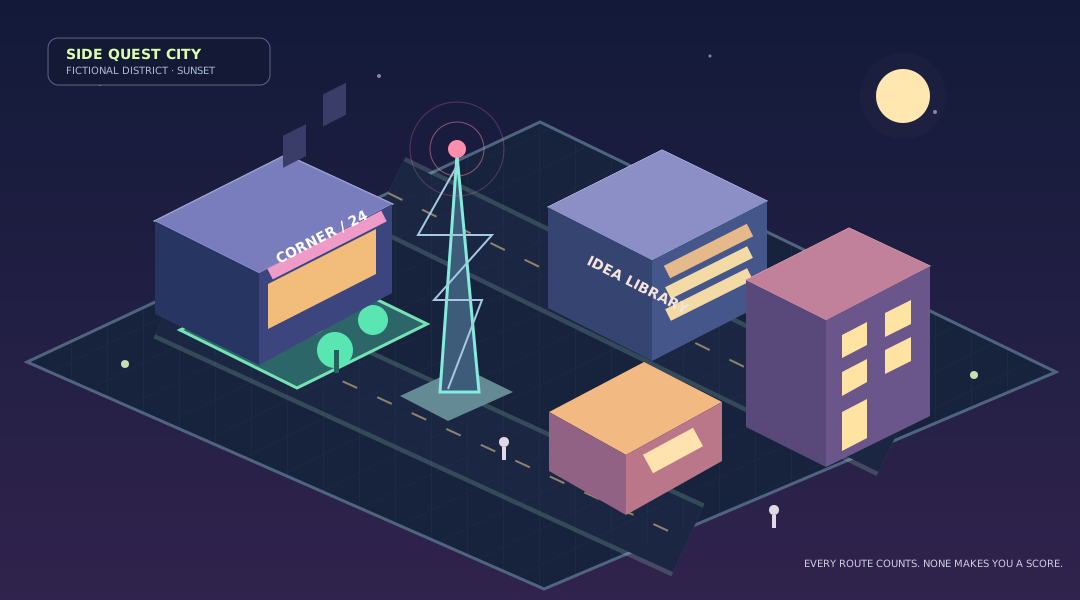
The picture is optional. Every district and activity is available as a text-labeled, keyboard-accessible control below. All residents and events are fictional composites. No private HQ data is used.
01 / THE PLAYABLE DAY
Pick a person. Not a potential score.
Meet six imaginary neighbours. They start with different obligations and different amounts of time and support. Nobody is the correct protagonist.
MAYA / A FICTIONAL MONDAY
A day with several good answers
A delivery may need attention this afternoon.
◷ 09:00 · 12h available
Energy
6
Money
5
Social bandwidth
6
Curiosity
6
Four transparent fictional resources for this day's choices. They are never measurements of ability, intelligence, confidence, mood or human worth.
02 / SIDE QUEST ENGINE
Where should the next hour go?
Choose a district or a quest. Every quest has two different ways to undertake it.
Pick your next side quest
A clear choice appears here, with its time and resource costs.
Nothing to prove. See what the city offers.
06 / ALTERNATE DAY REPLAY
What if you had done something else?
Revisit one quest and switch its approach. Everything after it replays with the same event seed. Your alternative is a transparent illustration, not a better-you prediction.
Played timeline
Complete a quest to compare timelines.
Alternate timeline
The counterfactual branch will appear here.
07 / KEEP, SHARE, OR DELETE
Your game stays yours.
No accounts, analytics or server requests are needed for gameplay. Save a fictional day locally, export its invented state as JSON, import an earlier export, or delete the saved data. Export files reflect your choices; inspect before sharing.
Rules, assumptions and the 'no ranking' promise
Resources range from 0 to 10 and mean only what this toy game says. Quest approaches have manually authored costs; times subtract from a 12-hour fictional window; a seeded event follows each action. Resource values are clamped to 0–10. Insufficient time or money makes some options unavailable. Events are indexed by turn, persona and seed, so two branches face equivalent interruptions at the same turn. Effects and opportunities are invented to ask questions, not to estimate real lives. Money is an abstract token, not rupees. There is no combined score, ideal persona, diagnosis, personality report, XP level or win state. Rest is an ordinary valid outcome.
08 / SIX STORIES FROM THE CITY
Neighbourhood dispatches.
Original fictional vignettes. None portrays an actual customer, acquaintance, family member or research contact.
FICTION / DISPATCH 01 · Maya Rao
The key that stays in the lock
Maya put a cup of tea beside the register and drew three small circles on a scrap of paper: stock, accounts, and a new idea for the window. Before she could choose one, a customer asked whether she had change for a large note. Another wanted a battery. A distributor called about a late carton. The scrap disappeared beneath a stack of receipts. At noon she found it again, marked with a tea ring. She laughed. The shop had not become a failure because the circles remained empty; in fact, several neighbours had been helped before lunch. But she could not assume that work done in response to others would eventually make room for work she had chosen. She turned the scrap over. Instead of three circles she wrote one sentence: 'After the delivery, fifteen minutes for my window.' It was neither a revolution nor a moral victory. It was an actual appointment with her own thought.
FICTION / DISPATCH 02 · Kabir Mehta
A résumé with a blank line
Kabir had prepared a magnificent answer to the question about his five-year plan. He could deliver it without pausing, which was useful in interviews and strangely unhelpful on a Friday evening. A friend asked what he wanted to do tomorrow. Kabir said he ought to complete a certification. Then he mentioned a small exhibition he had wanted to visit. Nobody told him what to choose. The uncomfortable part was discovering that both desires were his, and that the certificate might be useful while the exhibition might be delightful. The world would not collapse if a Saturday did not produce a new credential. Nor would curiosity pay every bill. He drew a line down a notebook page: what the next month required on one side, what he wanted to experience on the other. The line was not a wall. It was a way to make both visible.
FICTION / DISPATCH 03 · Tara Sen
Amber after midnight
Tara had made a scent that reminded her of an imagined monsoon library. She wanted to keep blending, but labels needed printing and a customer was waiting for an estimate. The formula on her workbench was incomplete; the invoice in her inbox was real. She wished inspiration and administration would agree on a schedule. They never had. That night she gave herself a rule: one careful evaluation strip, then the practical work. A new note was lovely, but not so lovely that it excused broken promises. Later, rinsing the measuring glass, she discovered that the pause had changed her opinion of the blend. The accord needed less sweetness. She wrote the observation down and went home. The unfinished bottle would wait. That was a decision, not an artistic defeat.
FICTION / DISPATCH 04 · Nisha Ali
An hour that belonged to no one
Nisha had spent the morning arranging appointments, answering ordinary questions and remembering what other people might forget. Her plans to learn illustration sat in a folder called 'soon'. When an afternoon opened unexpectedly, the folder seemed to glow. Then a neighbour asked for help. Nisha liked helping. She also wanted the hour for herself. She offered twenty minutes, not the whole afternoon, and returned to her desk with a familiar feeling: relief, mixed with a small suspicion that she should have done more. She drew a lopsided blue chair. The chair was not remarkable. What mattered was that she had kept an appointment with an interest that nobody else had assigned her. A relationship can be meaningful without every request becoming a command.
FICTION / DISPATCH 05 · Dev Kulkarni
The footnote that became a walk
Dev had six browser tabs open about a research question and a seventh about how to organise research questions. He had spent more time designing the filing system than testing the idea. A colleague invited him for a walk and he almost declined, citing momentum that was mostly imaginary. On the walk he explained his question out loud. Halfway through the second street he heard a missing assumption in his own explanation. He did not acquire a breakthrough by exercising, and the walk was not a secret productivity hack. Sometimes talking helps. Sometimes it doesn't. This time, the interruption made the problem easier to see. Back at his desk he closed the seventh tab and wrote a small test he could actually attempt.
FICTION / DISPATCH 06 · Zoya Khan
A song without an audience
Zoya had a loop she loved and a message asking whether she would post something new. The loop sounded alive through her headphones and uncertain through the laptop speakers. She tried to 'finish' it by adding layers, then removed most of them. Her friend arrived with samosas and a story that required no soundtrack. They ate on the floor. Later she listened to the loop again and saved it under a ridiculous filename. It might become a song; it might remain a private evening captured in sound. She still cared about craft and sharing her work. She also liked the possibility that a piece of music could matter before anybody clicked play. Neither belief had to cancel the other.
09 / THE PERSON BEHIND THE DASHBOARD
Field notes about a game that stops.
Original editorial writing, interpretations rather than reported empirical findings. Disagreement is welcome; these are invitations to reason, not moral measurements.
FIELD NOTE 01 / INTERPRETATION
The person behind the dashboard
A dashboard makes a careful promise: if you keep the categories stable, it will help you notice changes. A fuel gauge is excellent at telling you whether your tank needs attention. It is terrible at telling you where you should drive. A game resource bar works similarly. It can make a trade-off visible without becoming a verdict about the person making it.
Side Quest City shows energy, money, curiosity and social bandwidth only because they produce interesting choices within its invented rules. In an actual life those four labels would hide physical circumstances, friendship, power, disability, commitments, luck, history, humour and preference. The missing information is not just noise. Much of it is the life. This is why players can switch the bars off and still read the story.
Numbers are not villains. The mistake is allowing a convenient measurement to appoint itself judge. Our city borrows the pleasure of game feedback and declines the authority of a psychological profile.
FIELD NOTE 02 / INTERPRETATION
The dignity of the everyday counter
A small shop is not merely a convenient backdrop for entrepreneurial lessons. It is a place where delivery schedules collide with memory, trust, cash flow, mood, weather, and customers who have plans of their own. A successful transaction rarely captures all the attention and judgement involved.
The fictional shopkeeper cannot choose a perfect uninterrupted timetable; she can still create small pockets of freedom. The point is not that she should work harder or that the shop should be romanticised. Daily retail labour involves real repetition and pressure. It also contains forms of practical expertise that formal scoreboards may miss.
When the simulator gives the shop a disruptive supplier call, it is an authored constraint, not a claim about every shop in Delhi. The question is whether our story notices the work that makes other work possible.
FIELD NOTE 03 / INTERPRETATION
Why optimisation misses relationships
Two hours spent repairing a website are easy to name. Two hours listening to a friend can be equally consequential and far harder to evaluate. Relationships involve other minds with preferences that we cannot reduce to 'social points'. Our invented social-bandwidth bar is therefore a logistical shorthand, not a measure of affection.
One counterargument is important: schedules can protect relationships. A calendar reminder can help someone keep a promise; budgeting time may reduce avoidable neglect. The lesson is not to ban planning. It is to notice when the instrument stops being a servant and becomes a substitute for attention.
In the game, calling someone can consume time and restore a little connection resource. Real people are not vending machines that exchange minutes for intimacy. We state the simplification so that players can question it.
FIELD NOTE 04 / INTERPRETATION
When changing your mind is agency
Many heroic stories run on the same rhythm: choose a goal, persist, conquer adversity. Persistence can be admirable, and some difficult projects require it. But a good decision today may differ from yesterday's resolution because the relevant facts have changed.
The fictional researcher can abandon an elegant plan after an interruption reveals its hidden assumption. The perfumer can put the bottle down to honour a customer commitment. Neither choice proves a lack of dedication. Conversely, not every detour is wise. The meaningful distinction is between revising for reasons and avoiding a question we would rather not face.
Side Quest City doesn't know which distinction applies to your life. It only makes the trade-off legible. The actual judgement stays with the person outside the browser.
FIELD NOTE 05 / INTERPRETATION
Humane games and the exit door
Games are excellent at giving clear goals and immediate feedback. That is part of their charm. But an adult life simulator can quietly smuggle in a moral theory if every choice awards points and every evening must end with a higher level. We wanted the opposite ending: an exit that says your life outside the game is allowed to be more interesting.
There are useful criticisms of this design. Players sometimes like striving, mastery and winning; removing all tension can make a game bland. Our compromise keeps constraints, branches, surprising events and comparison. There is still something to learn from playing skilfully, but there is no universal leaderboard and no punishment for stopping.
The game congratulates you for closing it because design should sometimes acknowledge that attention is finite. Its success need not be measured by how long you remain here.
FIELD NOTE 06 / INTERPRETATION
The limits of a tiny simulation
Our rules are deliberately public. Each resident begins with four invented resources and twelve fictional hours. Every quest approach costs time and changes resources by known amounts. A seeded event arrives after each choice, and a replay keeps the event at that turn fixed so you can compare consequences under the same imagined interruption.
This is a toy system. It does not infer your personality or estimate the statistical effects of work, sleep or social connection. Real choices involve feedback, institutions, inequalities, hidden dependencies and consequences that resist quantification. Even a deterministic replay can make uncertainty disappear aesthetically when the world outside remains uncertain.
What can a toy model still do? It can show how assumptions organise a story. It can let someone ask whether a 'good outcome' depends on whose interests were counted. And it can prompt us to question the rules, including these ones. That is a modest ambition and a defensible one.
10 / EXPLORE RELATED WORLDS
Neighbouring ideas, not a link dump.
These independently published public works connect to specific questions in the city. Links were checked during preparation on 26 October 2026; availability can change.
The project’s public world.json records these editorial connections for a future catalogue. The unconfirmed field-note, fame and agency-machine URLs from the brief were intentionally excluded.
THE PRINTABLE COMPANION · 16 PAGES
The Non-Competitive Player Handbook.
Six situation maps, a reproducible event model, a day-budget worksheet, alternate-day templates, values mapping, clear assumptions and source notes. A meaningful field guide for the curious, not an application form for being good at life.
Maybe the best thing to do after playing is call someone, drink tea, repair something, work on your project, or do nothing at all. There is no streak to lose. We won't send a notification asking you to return.
No final score is calculated. No trophies are missing.